
Quick Summary
Traditional Building Automation Systems (BAS) are highly effective at managing HVAC and lighting, but they often lack the visibility and control needed for plug loads and demand response. As plug loads become a larger share of commercial building energy use, an endpoint-level control layer can extend building intelligence to the receptacle, making individual devices visible, measurable, schedulable, and controllable while complementing the existing BAS.
Building Automation Systems (BAS) have done more for commercial building efficiency than perhaps any other technology of the last forty years. Variable-air-volume resets, chiller plant sequencing, and occupancy-based lighting have all benefited from the centralized control and scheduling that a modern BAS provides. Yet the same systems that excel at managing HVAC and lighting consistently fall short in two areas that are only growing in importance: plug loads and demand response (DR).
This is not a failure of effort or vendor competence. It is a structural mismatch. A BAS was designed to control fixed, building-owned equipment from a central head end. Plug loads and demand response require endpoint visibility, fast local orchestration, and verifiable measurement at a granularity that traditional architectures were never built to deliver.
The plug load problem is getting bigger, not smaller
For decades, plug and process loads (PPLs) were an afterthought in commercial energy design because HVAC and lighting dominated the meter. That is no longer true. The National Renewable Energy Laboratory (NREL) reports that plug and process loads account for roughly 47% of U.S. commercial building energy consumption, a share projected to rise to 51% by 2029 as other end uses become more efficient [1]. Pacific Northwest National Laboratory (PNNL) puts miscellaneous and electronic loads at 15% to 40% of a typical office building’s total energy use, approaching or exceeding 50% in highly efficient buildings [2]. The U.S. Department of Energy summarizes it plainly: PPLs consume about one-third of primary energy in U.S. commercial buildings [3].
The implication for facility teams is uncomfortable. As lighting and HVAC get tighter and more efficient, the unmanaged plug load becomes the single largest controllable energy end use in the building. And it is the one the BAS is least equipped to touch.
Why traditional BAS misses plug loads
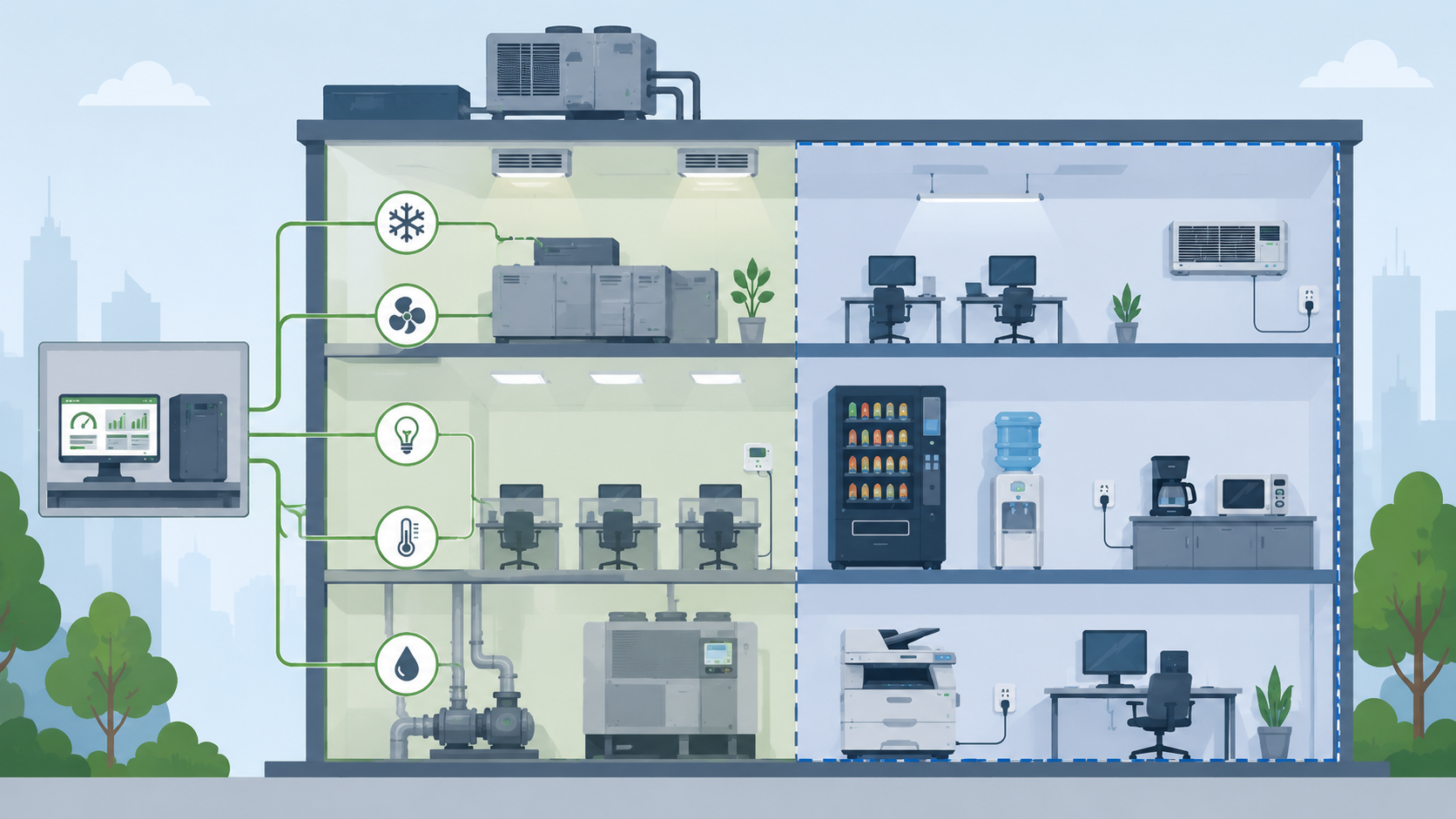
A BAS is, at its core, a supervisory control system for building systems: air handlers, central plant, pumps, lighting panels, meters, and alarms. It communicates with those systems over protocols such as BACnet, LonTalk, or Modbus. But a protocol is not a control point. BACnet can carry a command to shed load, but it does not create a controllable endpoint at every wall receptacle.
NREL’s work on streamlining plug load controls into BAS and energy management systems found that “plug load data and controls are not commonly integrated into Building Automation System (BAS) and EMIS platforms, although many have the capability to do so,” and that plug loads “are often not monitored or controlled” [4]. The conclusion was blunt: smart building systems remain very siloed.
This is not just an integration gap. It is a problem of architecture and scale. In practice, BACnet-based BAS networks become awkward when extended to hundreds of small receptacle-level devices. The issue is less the protocol’s existence than the data-point scale, the metadata model, gateway reliability, and the commissioning burden. Industry guidance notes that BACnet is “not suitable for managing endpoint devices” and is “unsuitable when a single method manages several dozen or even hundreds of small controllers,” because large numbers of devices saturate the network [5]. Field deployments bear this out. A University of California, San Diego study of plug load controllers integrated into a building energy management system over BACnet found that a network engine could support only a limited number of data points, that device metadata could only be stored in the controller’s name, and that the BACnet gateway was unreliable, sometimes issuing multiple ON commands for a single request [6].
Even when integrators push through these limits, the result is brittle. Researchers have noted that whole-building integration of plug load management with a BAS has been rare and difficult, “largely due to hardware interoperability and management scalability challenges” [7]. The California Energy Commission reached a similar conclusion, finding that plug load management platforms “generally lack support for both demand response and energy-saving automation strategies based on space, equipment type, and user presence” [8].
Plug loads are also distributed, mobile, and occupant-owned. They get unplugged, moved, and replaced constantly. A schedule that worked for a workstation last quarter may not match hybrid occupancy today. After-hours standby loads are a particular problem: studies have found that unoccupied loads can account for up to 75% of total plug load electricity in some offices [9]. A BAS running static time-of-day schedules cannot adapt to that reality without an endpoint layer that reports back what is actually drawing power. In practice, many facility teams rely on plug-in advanced power strips or smart outlets at the receptacle to close this gap, since the BAS head end has no native point at the wall [10].
Why demand response is even harder
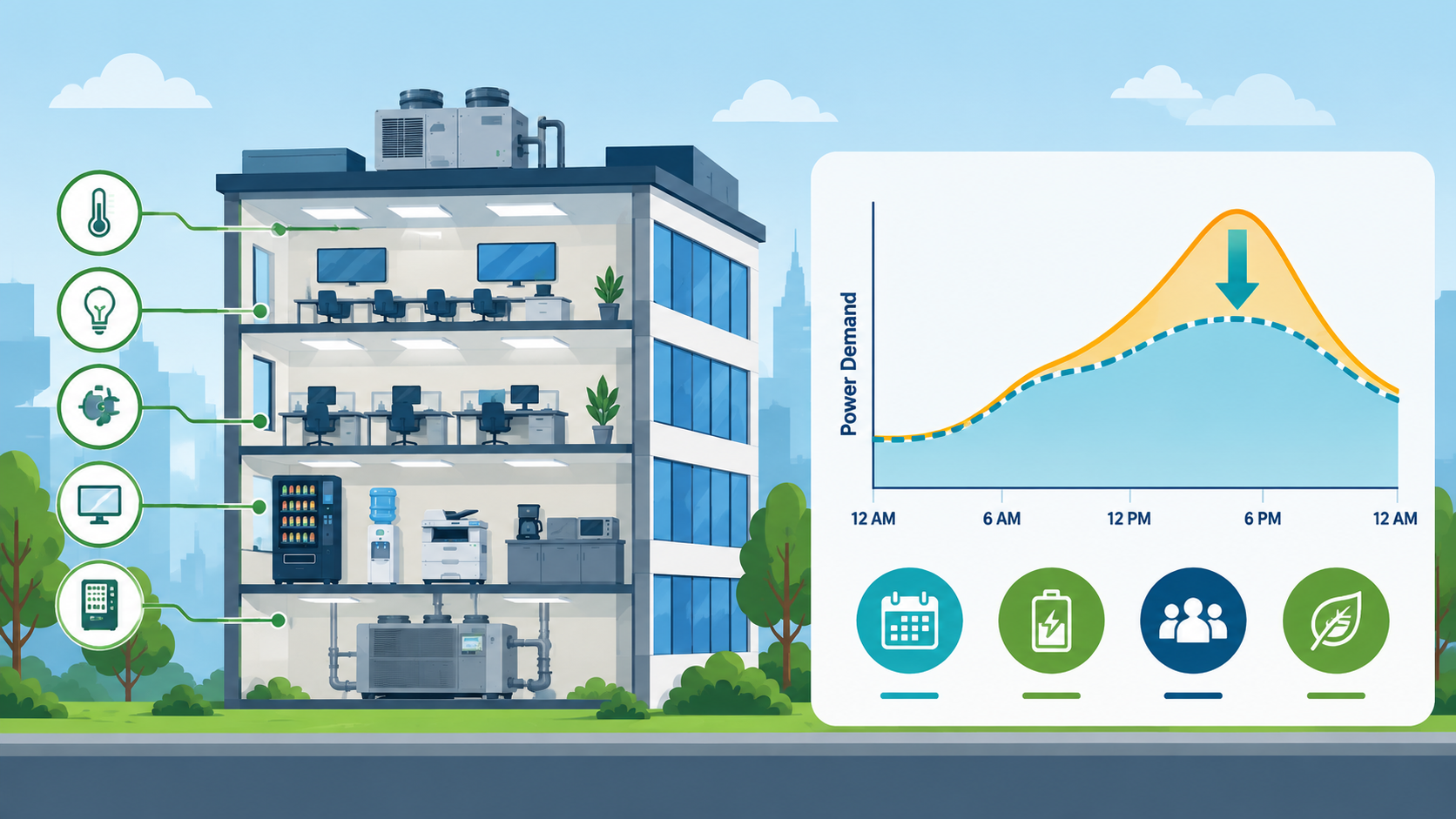
Demand response compounds every weakness above. The grid does not want a scheduled setback. It wants a dispatchable, measurable, verifiable reduction in kilowatts, delivered within minutes of a signal and proven with metered data. That requires three things a traditional BAS struggles to provide: fast and granular load shedding, reliable measurement and verification (M&V), and the ability to participate without compromising occupant comfort or productivity.
A BAS can typically shed HVAC (by resetting zone temperatures or pre-cooling) or lighting (by dimming or bi-level switching). These are the standard OpenADR DR strategies [11]. But shedding HVAC and lighting is the most visible and disruptive form of DR. It risks comfort complaints and productivity loss, and the shedded kilowatts are hard to predict because they depend on weather, thermal mass, and occupancy. That makes the resulting DR resource lumpy and hard to baseline.
Meanwhile, the largest and most flexible part of the load, the plug load, sits outside the BAS control boundary. Washington State University researchers put it directly: “a large amount of load (30% to 50%) has yet to be cast as a controllable resource under this paradigm: plug-loads,” and “no networking and control infrastructure exists within traditional commercial buildings which can easily incorporate plug loads” [12]. The OpenADR protocol solves the signaling problem between the utility and the building, but it does not, by itself, create controllable endpoints inside the building. A DR signal still needs a control layer that can act on it [13, 14].
That gap is what undermines many DR programs in practice. Field work by PG&E and others on OpenADR 3.0 found that the limiting factor was “not the OpenADR 3.0 communication pathway itself, but the surrounding operational context,” including “BAS reliability, power and network outages, and site-specific control-state persistence” [15]. In other words, the signal gets through. What is missing is a reliable set of endpoints to execute against it.
Energy codes have begun to force the issue. ASHRAE Standard 90.1, since the 2010 edition, requires automatic receptacle control for at least 50% of 125V, 15- and 20-amp receptacles in offices, conference rooms, break rooms, classrooms, and workstations, using occupancy, schedule, or signal-based control [16, 17]. Notably, the standard states that plug-in devices cannot be used to comply; the controlled receptacle itself must be switched. That is a code-compliance distinction, not an operational DR limitation: plug-in or outlet-level controls can still be valuable for energy management and demand response even where hardwired receptacle control is required for 90.1 compliance.
What a different architecture looks like
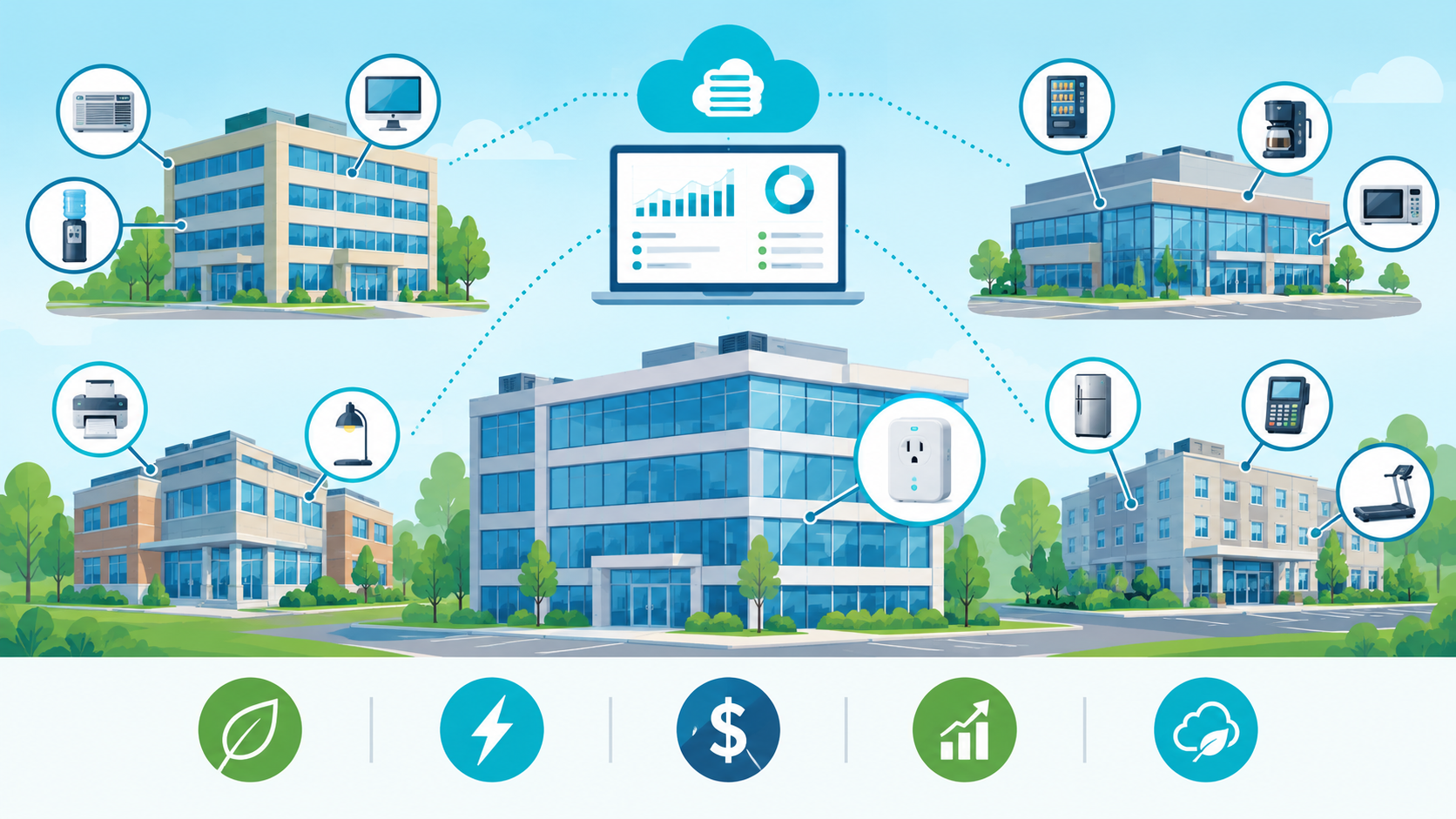
The fix is not a bigger BAS. It is a complementary layer purpose-built for the endpoint. The approach BOSS Controls takes, conceptually, is to move intelligence to the receptacle and the edge, then coordinate it from the cloud.
The architecture has three parts. First, device-level controllable outlets at the plug measure power at each endpoint, execute schedules, and switch it on or off, or into a low-power state where the connected device supports it. Second, a local gateway or edge controller on the building network manages those endpoints and provides a secure connection to the cloud. Third, a cloud platform that aggregates telemetry across many buildings, translates utility and grid signals such as OpenADR into control actions, and provides device-level measurement and verification.
This structure solves the problems a BAS cannot. It creates a controllable point at every outlet, which is the prerequisite for both plug load management and DR. It separates critical from noncritical loads, so a DR event can shed window AC units, dehumidifiers, water coolers, vending machines, and breakroom appliances without touching servers, workstations in active use, or life-safety equipment. It executes locally, which addresses the reliability and control-state persistence problems that have hampered DR in the field. And because every endpoint reports its own consumption, the system can show exactly which devices responded during an event, help facilities pre-test and reconcile performance against the utility meter, and make the next event more predictable. This complements rather than replaces utility interval-meter settlement, which most DR programs still use to calculate incentive payments [18, 19].
Aggregated across hundreds or thousands of outlets, these small loads become a meaningful, fast-responding grid resource. This is the logic of the grid-interactive efficient building: many small, controllable endpoints coordinated into a flexible load that can absorb renewable variability and shave peak demand. The OpenADR 3.0 design explicitly anticipates this, allowing a gateway at the building site to decouple grid-side communication from local device communication [20].
Crucially, this layer complements rather than replaces the BAS. The BAS continues to manage HVAC and lighting. The plug load layer handles the receptacle, where the BAS has no reach, and feeds verified, device-level data back so the facility team finally sees the load that has been invisible to the head end.
A practical starting point
For facility teams, the path forward does not require a rip-and-replace. It starts with an inventory of plug loads and a simple segmentation of critical versus noncritical equipment. The first targets should be low-risk, high-waste loads: window AC units, PTACs, monitors and task lighting left on after hours, printers and copiers, vending machines, water dispensers, breakroom appliances, and common-area chargers. These can be scheduled and shed with minimal impact on occupants, and they are often where after-hours standby waste is largest.
From there, integrate occupancy and schedule data, subscribe to utility DR signals where available, run test events, and refine. The goal is not to control every outlet. It is to make the controllable portion of the load visible, schedulable, and dispatchable, and to prove the result with measured data.
The underlying problem is not that BAS technology is poor. It is that the load has moved. HVAC and lighting were the story for forty years, and the BAS handled them well. Plug loads are the story now, and they are growing. Meeting them requires meeting them where they live, at the receptacle, with a control layer built for that scale and that speed. A plug-load-centered architecture does exactly that, and in doing so turns the building’s largest unmanaged end use into a controllable, verifiable grid resource.
Key Takeaways
- Traditional BAS leaves a significant portion of building loads unmanaged. Plug loads such as window A/C units, vending machines, water coolers, printers, and office equipment often fall outside the BAS control boundary.
- Plug loads are becoming too significant to ignore. As HVAC and lighting become more efficient, unmanaged plug loads represent an increasingly important opportunity for energy savings.
- Demand response requires more than a grid signal. Effective DR depends on fast, granular control, reliable measurement, and verifiable load reduction at the device level.
- Endpoint-level control fills the BAS gap. Smart outlets and controllers provide the visibility and control needed to manage loads that traditional BAS architectures cannot easily reach.
- Granular control can reduce operational disruption. Facilities can target noncritical loads while protecting servers, active workstations, critical areas, and other essential equipment.
- Device-level measurement strengthens energy management and DR. Measuring individual loads provides the data needed to identify waste, establish baselines, verify savings, and document DR performance.
- A complementary architecture is more practical than replacing the BAS. The BAS can continue managing HVAC and lighting while an endpoint layer manages plug loads and provides additional visibility.
- Plug-load control creates a pathway to grid flexibility. Aggregating hundreds or thousands of controllable devices can transform previously unmanaged loads into a meaningful, dispatchable demand response resource.
- The best place to start is with an assessment. Identify high-waste, low-risk plug loads, segment critical and noncritical equipment, establish baseline consumption, and determine where automated control can deliver measurable savings.
References
1. National Renewable Energy Laboratory, “Assessing and Reducing Plug and Process Loads in Office Buildings,” NREL. https://docs.nrel.gov/docs/fy20osti/76994.pdf
2. Pacific Northwest National Laboratory, “Characterizing Plug Load Energy Use and Savings Potential in Commercial Buildings,” PNNL. https://www.pnnl.gov/main/publications/external/technical_reports/PNNL-29914.pdf
3. U.S. Department of Energy, “Myth-Busting Barriers Associated with Plug Load Controls.” https://www.energy.gov/eere/buildings/articles/myth-busting-barriers-associated-plug-load-controls
4. National Renewable Energy Laboratory (Trenbath), “Streamlining IoT Plug Load Controls into BAS and EMIS.” https://www.energy.gov/sites/prod/files/2018/06/f52/22291c_Trenbath_050318-1330.pdf
5. Wattsense, “BACnet: Everything You Need to Know.” https://www.wattsense.com/resources/glossary/what-is-bacnet/
6. UC San Diego GridLab, “Advanced Plug Load Operations Strategies in Building Energy Management Systems.” https://gridlab.ucsd.edu/wp-content/uploads/2024/09/Advanced-Plug-Load-Operations-Strategies-in-Building-Energy-Management-Systems.pdf
7. UC San Diego, “Integration of a Smart Outlet-Based Plug Load Management System with a BAS.” https://escholarship.org/content/qt79j9v0s7/qt79j9v0s7_noSplash_4227257d18659812ce3635873bb393d0.pdf
8. California Energy Commission, “Flexible Control Strategies for Plug Loads to Mitigate Electricity Waste and Support Demand Response,” CEC-500-2023-001. https://www.energy.ca.gov/sites/default/files/2023-03/CEC-500-2023-001.pdf
9. ScienceDirect, “Office Building Plug and Light Loads: Comparison of a Multi-Parametric Approach.” https://www.sciencedirect.com/science/article/abs/pii/S0378778817315001
10. Inside Lighting, “What Is Plug Load Control and Why It Matters.” https://inside.lighting/news/26-03/what-plug-load-control-and-why-it-matters
11. BACnet Journal, “OpenADR Advances.” https://bacnet.org/wp-content/uploads/sites/4/2022/06/Holmberg-2012.pdf
12. Washington State University, “An Architecture for Enabling Distributed Plug Load Control for Demand Response.” https://eecs.wsu.edu/~bakken/IEEE-PES-ISGT-2013/files/ISGT2013-000257.PDF
13. OpenADR Alliance, “Demand Response Program Implementation Guide.” https://www.openadr.org/assets/openadr_drprogramguide_v1.0.pdf
14. Lawrence Berkeley National Laboratory, “Automated Demand Response Technologies and Demonstration in New York City using OpenADR.” https://eta.lbl.gov/publications/automated-demand-response-0
15. ACEEE, “Field Performance of OpenADR 3.0.” https://www.aceee.org/sites/default/files/proceedings/ssb26/pdfs/322_0959_1434_001205.pdf
16. ASHRAE, “Standard 90.1, Section 8.4.2 Automatic Receptacle Control.” https://www.ashrae.org/file%20library/technical%20resources/standards%20and%20guidelines/standards%20addenda/90_1_2016_k_o_x_ab_ac_ad_ae_ag_ah_ak_am_20210324.pdf
17. National Institutes of Health, Office of Research Facilities, “Automatic Receptacle Control Technical Bulletin” (ASHRAE 90.1-2019, Section 8.4.2). https://orf.od.nih.gov/TechnicalResources/Documents/Technical%20Bulletins/20TB/Automatic%20Receptacle%20Control%20%20August%202020%20-%20Technical%20Bulletin_508.pdf
18. Pacific Gas and Electric, “Automated Demand Response Program Manual.” https://www.pge.com/assets/pge/docs/save-energy-and-money/energy-savings-programs/adr-program-manual.pdf
19. Southern California Edison, “Automated Demand Response Control Incentives Handbook.” https://www.sce.com/sites/default/files/2022-05/Auto-DR%20Program%20Handbook%204.27.22.pdf
20. ACEEE, “Transforming Demand Response Using OpenADR 3.0.” https://www.aceee.org/sites/default/files/proceedings/ssb24/assets/attachments/20240722163109015_bb500916-3461-4580-816a-9ef02398162d.pdf