
Quick Summary
Plug loads use about a third of the electricity in U.S. commercial buildings, but most sit outside the building automation system and keep running during demand response events. Intelligent plug load control adds device-level metering, remote switching, and network connectivity, so equipment like vending machines, water coolers, and supplemental A/C units can shed load automatically when a utility or grid operator sends a signal. This article explains how automated demand response works, how a plug load event runs from signal to settlement, which devices make good candidates, and how to get started.
Introduction: The Missing Piece in Building Demand Response
When a utility or grid operator calls a demand response event, most commercial buildings respond the same way: they raise cooling setpoints, dim lights, and hope it’s enough. Those systems run through the building automation system (BAS), so they’re relatively easy to adjust. Everything plugged into the wall is a different story.
Plug and process loads account for about one-third of U.S. commercial building electricity consumption, according to the National Renewable Energy Laboratory (NREL), and their share is growing as lighting and HVAC become more efficient [1]. Yet most of this equipment, from water coolers and vending machines to supplemental window air conditioners and space heaters, has no connection to the BAS, no metering, and no way to respond to a grid signal. During a demand response event, it simply keeps running.
Intelligent plug load control changes that. By adding measurement, remote control, and network connectivity at the outlet, it turns scattered plug-in devices into a coordinated, automated demand response resource. This article explains how automated demand response works, why plug loads were long left out, and how facility teams can bring them in.
What Is Automated Demand Response?
Automated demand response (automated DR) uses electronic signals from a utility, grid operator, or aggregator to trigger pre-programmed load reductions in a building without anyone having to act manually. Researchers at Lawrence Berkeley National Laboratory (LBNL) began work on automated DR communications in 2002, and that research led to OpenADR, an open specification that uses price, reliability, or event signals to trigger customers’ pre-programmed responses automatically [2]. Automation makes a building’s response more repeatable and reliable than relying on staff to walk the floors when an event is called.
The results can be substantial. In an LBNL field demonstration with large commercial buildings in the Pacific Northwest, automated DR delivered an average demand reduction of 14% over three-hour winter events and 16% over five-hour summer events, mostly through HVAC and lighting strategies [2].
The standard keeps evolving. OpenADR 3.0, released in late 2023, is designed to support a shift from occasional, event-based demand response toward continuous demand flexibility, communicating price and capacity information to a much wider range of building loads, gateways, and devices [3].
Why Plug Loads Were Left Out
Automated DR programs have historically focused on HVAC and lighting because those systems are centrally controlled. Plug loads present three obstacles:
- They’re distributed. Hundreds or thousands of small devices are spread across floors and buildings, each with its own on/off switch.
- They’re invisible. Without metering, there’s no way to know how much power a group of devices is drawing, or how much was reduced during an event.
- They’re not connected. Few plug-in devices can receive a network signal, and fewer still can respond to one.
Individually, a vending machine or a water cooler is a small load. Collectively, plug loads in a large building or portfolio can add up to hundreds of kilowatts, a meaningful resource that has gone mostly unused.
What Makes a Plug Load “Intelligent”
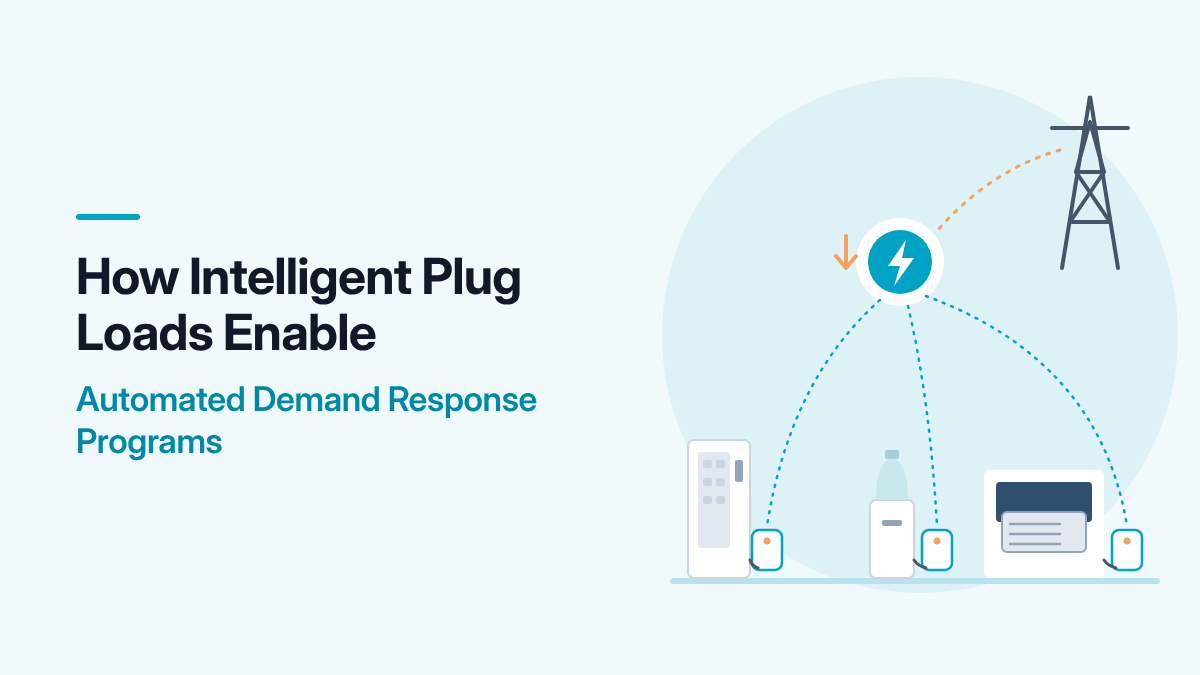
An intelligent plug load control system, such as a network of smart plugs managed from a cloud platform, adds the capabilities that automated DR requires:
- Device-level metering. Each controller measures power and energy, so the system knows what is running and how much load is available to shed.
- Remote switching. Devices can be turned off or on individually or in groups from a central platform.
- Connectivity. Controllers communicate over the building’s network, so they can receive dispatch commands from the platform, which in turn can receive signals from a utility, aggregator, or OpenADR server.
- Grouping and priorities. Devices can be organized by location, type, or criticality, so the least disruptive loads are shed first.
- Overrides and logging. Occupants or managers can override a device when needed, and every action is recorded for verification.
How an Automated Plug Load DR Event Works
With these capabilities in place, a plug load DR event typically follows six steps:
- Enrollment and setup. The facility team assigns devices to shed tiers, sets maximum curtailment durations for each, and connects the control platform to its utility or aggregator program.
- Signal received. Hours ahead for most capacity events, or minutes ahead for faster programs, the platform receives an event notice through OpenADR or the aggregator’s interface.
- Automated shed. At the event start, the platform switches off devices tier by tier until the committed reduction is reached. No staff action is needed.
- Monitoring and overrides. Real-time metering confirms the reduction. If a device is needed, an authorized user can override it, and the platform can shed another device to compensate.
- Staggered restore. When the event ends, devices are restored in stages rather than all at once, avoiding a sudden rebound spike that could set a new demand peak.
- Measurement and verification. Interval data from each controller documents the reduction against the program’s baseline for settlement.
One rule shapes how these events are designed. Grid operators pay only for reductions beyond normal operations. PJM Interconnection, for example, states that demand response “does not include reductions in electricity use that follow normal operating patterns or behavior,” and pays through curtailment service providers that aggregate customers, offer their reductions into the market, and submit load data to verify them [4]. Equipment already scheduled off at night is efficiency, not demand response; DR value comes from loads that would otherwise be running during the event window.
Which Plug Loads Make Good DR Resources?
The best candidates can be switched off for an hour or more without disrupting people or operations:
- Beverage and vending equipment: refrigerated vending machines, water coolers, and chilled water fountains, which have thermal mass and recover quickly.
- Supplemental heating and cooling: window air conditioners, portable air conditioners, and space heaters, often large loads, best cycled briefly or shed in unoccupied rooms.
- Shared office equipment: printers, copiers, and coffee makers, especially in break rooms and print areas.
- Displays and signage: lobby screens, decorative displays, and televisions.
Some loads should be excluded or tightly limited: network and IT equipment, medical or laboratory devices, life-safety equipment, and refrigeration that stores food or medicine, unless curtailment is short and carefully tested.
One Device, Two Revenue Streams
The same smart plug that sheds load during a DR event also saves energy every day by switching equipment off when spaces are empty. A U.S. General Services Administration (GSA) study conducted with NREL found that schedule-based plug load control reduced plug loads at workstations by 26%, even with computer power management already in place, and by nearly 50% in printer rooms and kitchens [5].
BOSS Controls reports similar results from its own deployments. In a project with a large Mid-Atlantic city, a local university, and the city’s largest office tower, scheduling cut energy use by more than 50% for targeted plug loads, with simple paybacks under one year, and cloud-based control supported automated DR events down to the individual plug. Using 2015/16 PJM capacity prices, BOSS estimated about $9.10 a year in DR value per plug. PJM’s capacity price for the 2028/2029 delivery year cleared at $325 per MW-day [6], compared with $136 per MW-day for most of PJM in 2015/16 [7], which would put the same estimate at roughly $22 per plug a year before the aggregator’s share.
Energy Savings Calculator
See what the everyday savings could be in your building. Enter your plug-in equipment to estimate annual energy use, annual and five-year savings, and CO2 avoided.
Codes and Markets Are Moving the Same Way
Policy is pushing plug loads toward grid interactivity. California’s Title 24, Part 6 already requires automatic control of at least half of the 120V receptacles in offices and certain other spaces, and the 2025 Energy Code, which applies to permit applications filed on or after January 1, 2026, extends these controlled receptacle requirements to include response to demand response signals [8].
Wholesale markets are opening up too. FERC Order No. 2222 requires grid operators to let aggregations of distributed energy resources as small as 100 kW participate in wholesale energy, capacity, and ancillary services markets, with implementation phased by region [9]. As an illustration, at about 0.2 kW of sheddable load per device, roughly 500 smart plugs across a campus or portfolio would reach that 100 kW threshold.
Getting Started: A Checklist for Facility Teams
- Inventory and meter. Identify plug loads that are on during typical event hours (often weekday afternoons) and measure their actual demand.
- Assign shed tiers. Rank devices from least to most disruptive, set maximum off-times, and exclude critical equipment.
- Lock in efficiency first. Schedule unneeded loads off during unoccupied hours before setting DR commitments, so commitments reflect real event-hour load.
- Connect to a program. Talk with your utility or an aggregator about program rules, notification times, metering requirements, and how they connect to your control platform, including whether they use OpenADR.
- Test before you commit. Run a test event, check occupant impact and measured reduction, and size your commitment conservatively.
- Communicate with occupants. Explain what will switch off, when, and how to request an override.
- Review every season. Use event data to adjust tiers, add devices, and refine commitments.
Conclusion
Plug loads have long been the blind spot of building demand response: too scattered to manage, too invisible to verify, and too disconnected to automate. Intelligent plug load control removes all three barriers. With device-level metering, remote control, and connectivity to utility and aggregator signals, plug-in equipment can shed load automatically during grid events, save energy every day through scheduling, and provide the verified data that programs require. As codes begin to require demand-responsive receptacles and markets open to smaller aggregations, plug loads are becoming one of the most practical ways for commercial buildings to join automated demand response programs.
Key Takeaways
- Plug and process loads use about one-third of commercial building electricity [1], but most sit outside the BAS and can’t respond to grid signals on their own.
- Automated DR uses utility, grid operator, or aggregator signals, often through the OpenADR standard, to trigger pre-programmed load reductions without manual action [2][3].
- Intelligent plug load control adds the metering, remote switching, connectivity, priorities, and logging needed to make plug loads a reliable, verifiable DR resource.
- A well-designed event sheds devices by priority, allows overrides, restores loads in stages to avoid rebound peaks, and documents the reduction for settlement.
- The same devices deliver daily efficiency savings; GSA and NREL measured 26% to nearly 50% plug load reductions from scheduling alone [5].
- California’s 2025 Energy Code requires controlled receptacles to respond to demand response signals [8], and FERC Order No. 2222 opens wholesale markets to aggregations as small as 100 kW [9].