Quick Summary
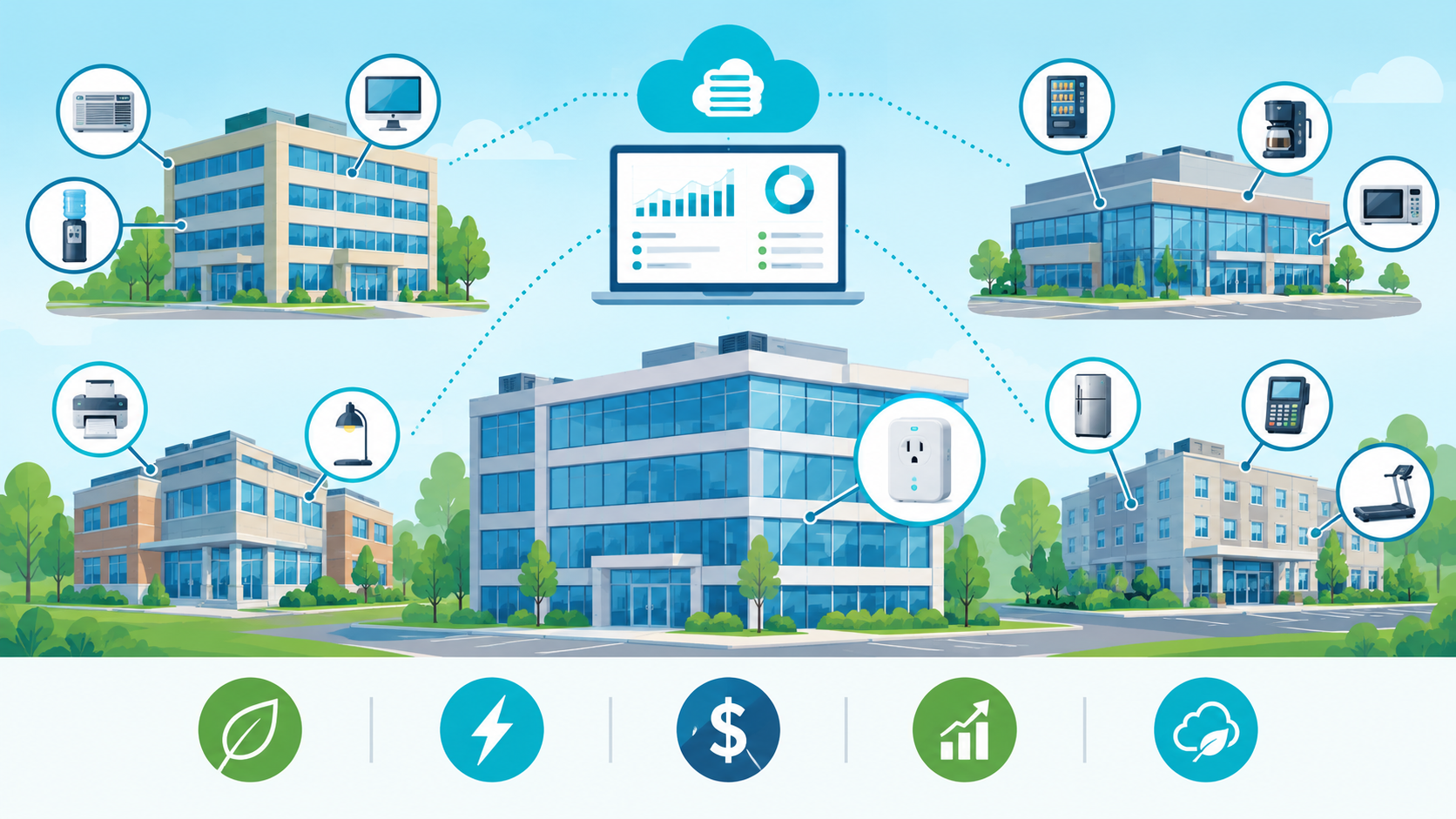
Plug loads, the electricity used by equipment plugged into receptacles, are becoming a larger share of commercial building energy use as lighting and HVAC systems improve. NREL notes that plug loads account for more than 16% of commercial building electricity consumption and are expected to grow. Distributed devices such as vending machines, water fountains, window AC units, televisions, heaters, and workstations can be difficult to manage manually. The lesson is not that every outlet should be switched off; it is that buildings need a deliberate strategy based on inventory, device suitability, occupancy patterns, controls, and user education.
Why plug loads deserve more attention
For years, building energy programs focused first on lighting retrofits, HVAC upgrades, and envelope improvements. As those systems become more efficient, the unmanaged equipment plugged into walls becomes harder to ignore.
NREL’s fact sheet on automatic receptacle controls explains why plug loads are stubborn: devices are often left on when not in use, many draw standby power, and some continue to consume electricity even when apparently turned off. These “vampire” or parasitic loads are individually small, but across a school, office, stadium, campus, or municipal building they add up.
The operational challenge is fragmentation. A facilities team can adjust an air handler from a building automation system, but a water cooler, lobby display, coffee maker, monitor, or portable heater may be controlled only by the last person who touched it. In practice, many devices run overnight, through weekends, and during holidays.
What automatic receptacle controls do
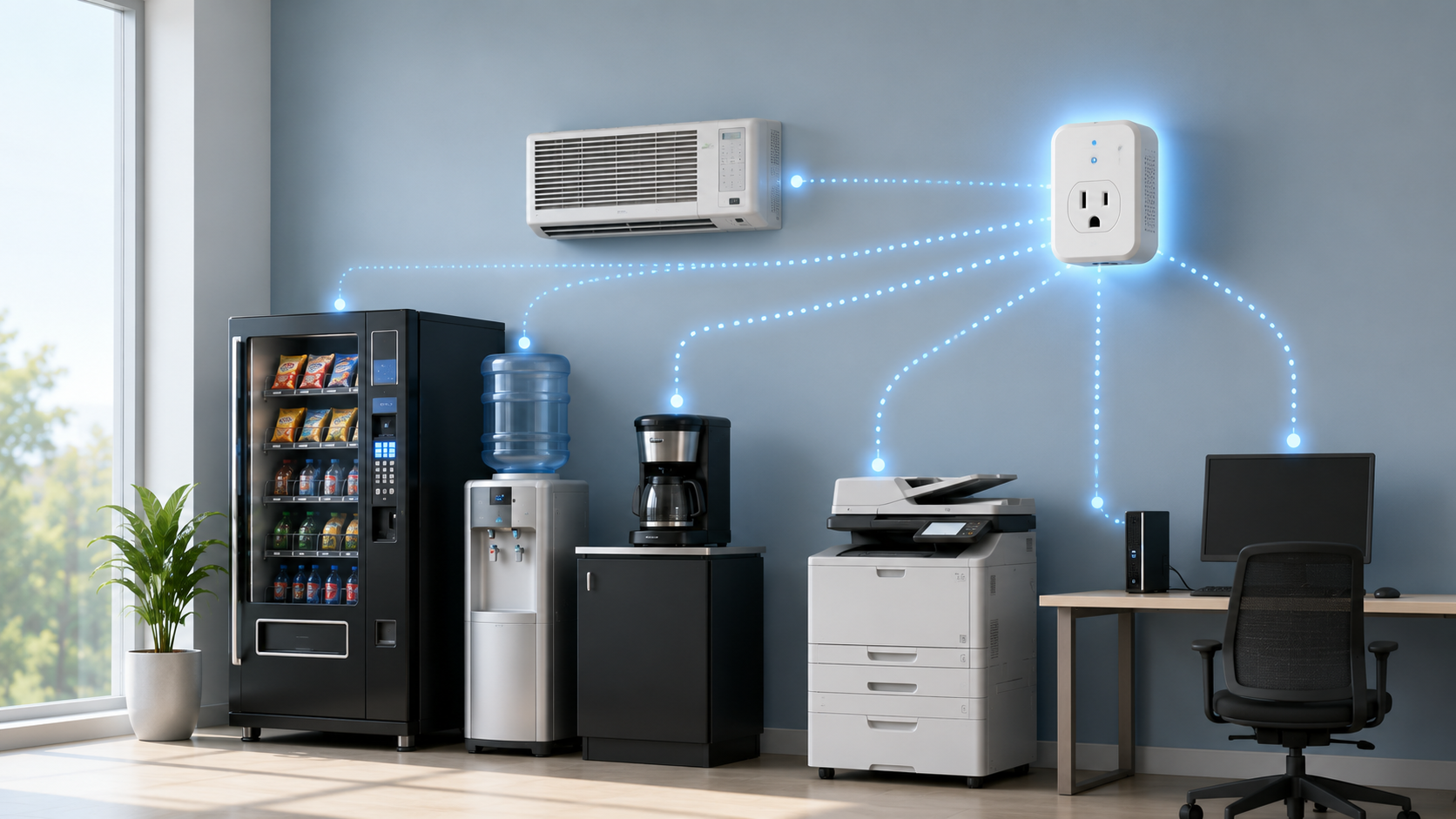
Automatic receptacle controls, often called ARCs or plug-load controls, provide an automatic way to turn receptacles on and off. According to the NREL, common approaches include schedule-based control, occupancy-based control, and system-based control using signals from another building system such as security or building automation.
Each method fits a different operating pattern. A printer, water cooler, vending machine, or display in a predictable-use area may be a good candidate for a schedule. A conference room, private office, classroom, or intermittently used space may be better suited to occupancy-based control. A larger facility may benefit from system-based signals that coordinate plug loads with occupied and unoccupied modes.
The best controls also preserve usability. NREL notes that many systems allow a manual override, often for up to two hours. A rigid schedule that frustrates occupants can create workarounds, including extension cords or uncontrolled outlets. Savings depend not only on the device but also on trust, labeling, and clear guidance.
Savings start with knowing the load
The BOSS Controls approach is to measure plug loads before broad action. In education-facility pilots, BOSS and partners surveyed plug-load consumption, operating hours, and equipment profiles before comparing uncontrolled and scheduled periods. Heavy loads such as refrigerated vending machines, water fountains, window AC units, electric heaters, and large televisions produced meaningful savings when controlled during unoccupied periods. Some smaller devices also performed well, while other equipment, such as certain copiers, did not consume enough to be a priority.
That is an important point regarding deployment priority: plug-load control is not about indiscriminately cutting power. Some equipment should remain on for safety, health, IT, refrigeration, security, or operational reasons. Network equipment, medical devices, laboratory equipment, and critical systems require careful review. The highest-value savings usually come from matching controllable devices with predictable downtime.
Real-world consumption reinforces this prioritization mindset. Average draw and annual usage vary dramatically: cooling, heating, vending, and appliance loads to smaller office and specialty devices. Even if exact numbers vary by building, inventory turns a vague “plug-load problem” into a ranked list of opportunities.
Codes are pushing the issue
Plug-load control is also becoming a compliance topic, not only an efficiency option. NREL summarizes ARC provisions in ASHRAE 90.1, California Title 24, and the 2021 IECC. These provisions generally require a portion of receptacles in certain commercial spaces to be automatically controlled and permanently marked, with acceptable strategies such as schedules, occupancy sensors, or signals from other systems. California’s 2022 Title 24 provisions also connect controlled receptacles to demand-response capability in applicable buildings.
For building owners, this means the design conversation should happen early. Which receptacles are controlled? How are they marked? Which devices belong on controlled versus uncontrolled outlets? How will overrides work? Who updates schedules when space use changes? A compliant installation can still underperform if occupants do not understand it.n
Retrofitting existing buildings
Retrofitting wiring for older buildings with ARC is a big expense for electricians and potentially creates occupant disruption. Aneasier approach is to retrofit buildings with wireless plug-control devices that simply plug into existing outlets and connect wirelessly to a centralized control system. This is the approach offered by BOSS Controls with the SmartEdge platform. SmartEdge retrofits easily, connected to an overlay in-building wireless network and sends data to the cloud platform through a cellular gateway. This means there is no impact to the client WiFi network and no permissions or tunnels are required.
Operational lessons for facilities teams
The strongest plug-load programs are practical rather than theoretical. Start with an inventory and interval measurements where possible. Separate devices into categories:
- Always-on
- Schedule-friendly
- Occupancy-sensitive
- Seasonal
- Questionable
Focus first on devices with high wattage, long idle hours, or many repeated instances across a portfolio.
Next, align control logic with real operations. Schools have long vacancies but complex calendars. Offices may have hybrid schedules and variable conference-room use. Stadiums and event spaces may have intense but intermittent occupancy. A plug-load strategy should reflect those patterns rather than impose a generic shutoff time.
Finally, make the human layer explicit. Label controlled receptacles or wireless plug-control devices. Explain which equipment should be plugged into them. Provide a simple override process. Review exceptions. Revisit schedules after holidays, semester changes, tenant moves, or renovations.
Plug-load energy savings sit at the intersection of devices, occupants, controls, codes, and operations. Managed well, they can reduce wasted energy without reducing useful service and make everyday equipment a visible part of building energy management.
Key Takeaways
- Plug loads are a growing share of commercial building electricity use, especially as lighting and HVAC become more efficient.
- Automatic receptacle controls and plug-control devices can use schedules, occupancy sensors, or building-system signals to reduce unnecessary runtime.
- The best opportunities come from inventorying devices and prioritizing equipment with high consumption and predictable idle periods.
- User education, labeling, and override options are essential to prevent workarounds and maintain occupant trust.
- Plug-load control should be treated as an operational program, not just a one-time installation or code checkbox.