
Quick Summary
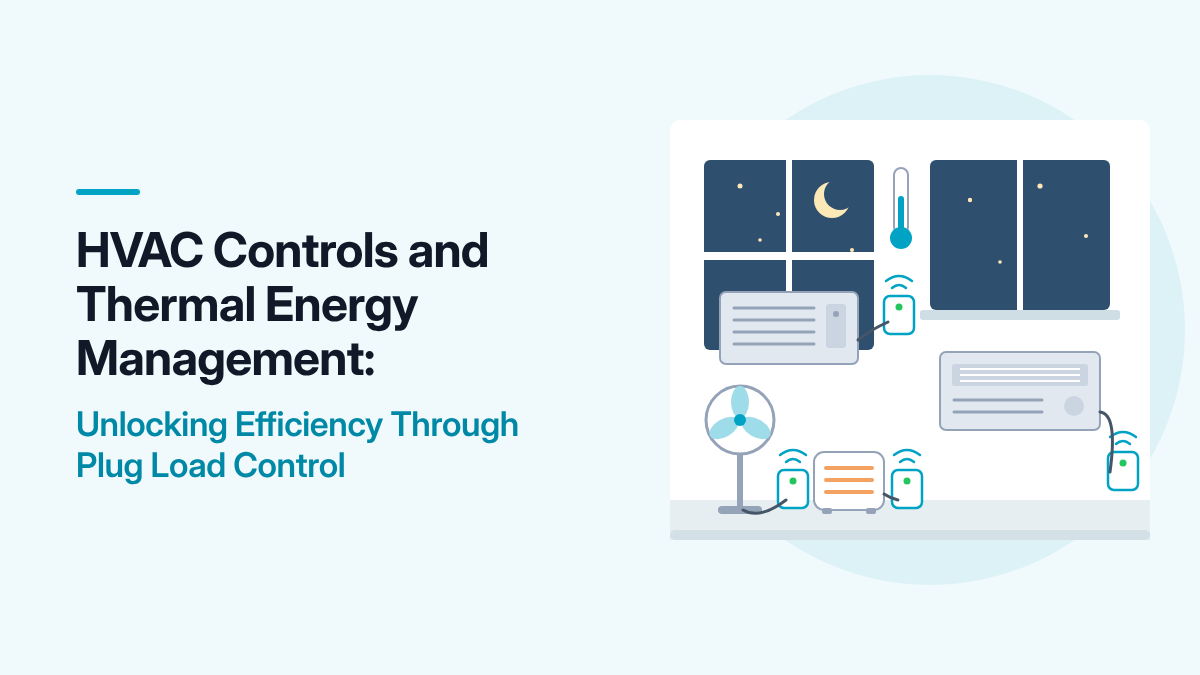
HVAC-related plug loads, such as window air conditioners, PTACs, portable heaters, and fans, often run outside the building automation system and keep operating through nights and weekends. Bringing them under centralized plug load control, such as BOSS Controls smart plugs, cut energy use by more than 50% for targeted devices in deployments reported by BOSS Controls, with paybacks often under a year and no major capital upgrades. This article explains how the technology works, what savings to expect, how it supports demand response and virtual power plants, and how to roll it out.
Introduction: The Overlooked HVAC Plug Load Problem
Commercial buildings contain countless electrical devices that fall outside the scope of traditional building automation systems (BAS). Among these, HVAC-related plug loads such as window air conditioning units, packaged terminal air conditioners (PTACs), space heaters, and fans are particularly problematic. These devices often operate independently, with limited scheduling capabilities, and are frequently left running during nights, weekends, and holidays when spaces are unoccupied. Unlike central HVAC systems, which a BAS can schedule, plug-in thermal devices lack native integration points, making them invisible to standard energy management strategies.
The scale of the issue is significant. The National Renewable Energy Laboratory (NREL) reports that plug and process loads account for about one-third of U.S. commercial building electricity consumption, and cites DOE projections that their energy use will grow about twice as fast as total commercial building energy use as lighting and HVAC become more efficient [1]. Within this category, HVAC-related plug loads are a substantial fraction, especially in older buildings that rely on window units or supplemental heating and cooling. They waste energy in two ways: standby (“phantom”) power draw when nominally off, and active operation during unoccupied periods.
Traditional approaches to managing these loads, such as manual shut-off policies or basic timers, are often ineffective because occupant behavior is inconsistent and timers offer little visibility or remote control. Facility managers need a solution that provides centralized control, real-time visibility, and automated scheduling without extensive rewiring or major capital expenditure. Plug load control technology fills this gap by turning ordinary plug-in devices into measurable, controllable, and grid-interactive assets.
How Plug Load Control Works for HVAC Devices
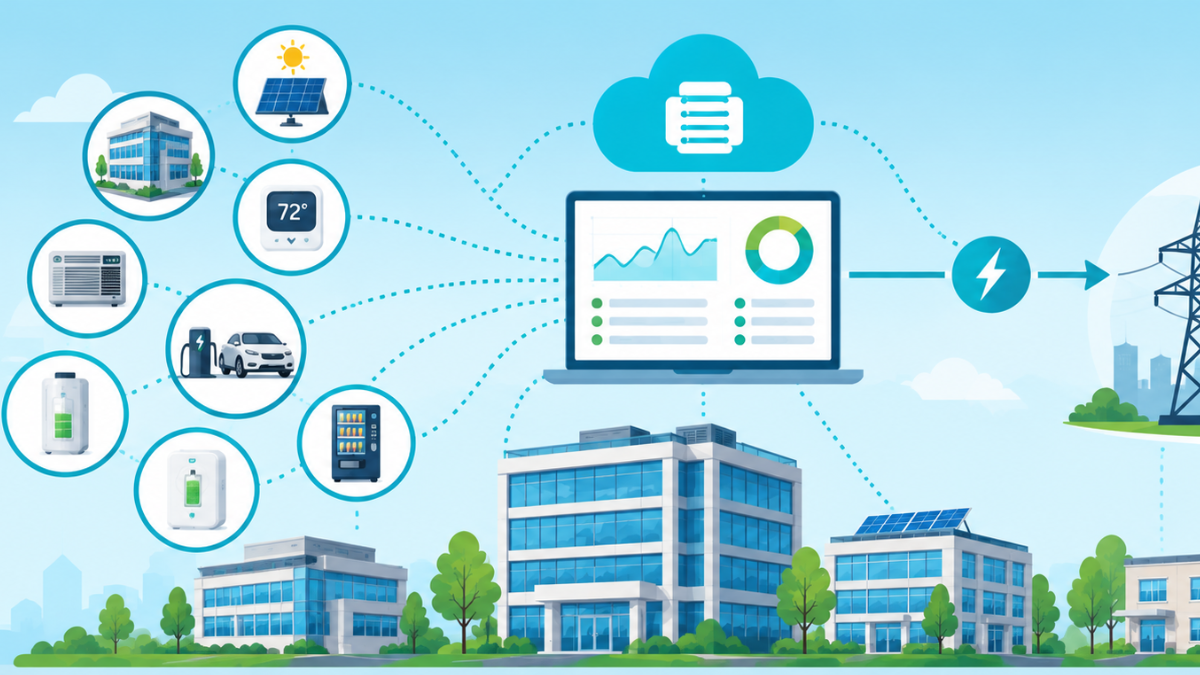
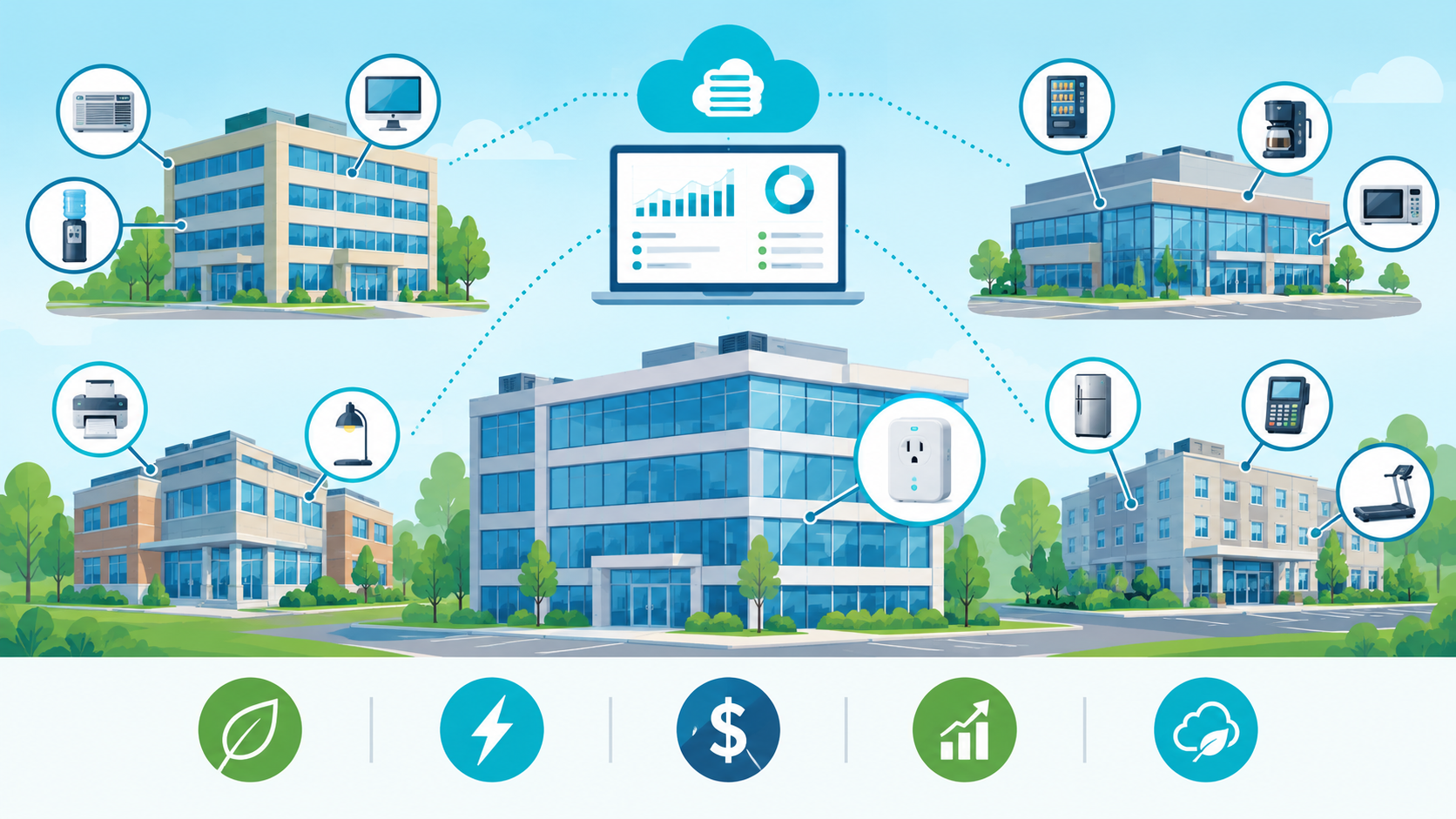
Modern plug load control solutions, such as the BOSS Smart Edge system, retrofit existing outlets with intelligent controllers that enable remote management and device-level energy monitoring. The controllers either replace standard wall outlets or sit between the outlet and the plug, and connect to a cloud platform (such as BOSS’s Atmospheres®) over Wi-Fi or other wireless protocols.
For HVAC-related plug loads, the core functions include:
- Scheduling: Devices can be programmed to turn off during unoccupied periods (nights, weekends, holidays) and power on before occupancy resumes.
- Remote control: Facility managers can adjust schedules or shut devices down immediately from any location through a web portal or mobile app.
- Real-time monitoring: Power (watts) and energy (kilowatt-hours) are measured at the device level, giving granular data on consumption patterns.
- Grouping: Devices can be organized into virtual groups by floor, building, or device type for coordinated control.
- Alerts and notifications: The system can flag anomalies, such as a device drawing power outside scheduled hours.
Crucially, none of this requires modifying the HVAC equipment itself. A window AC unit simply plugs into the smart controller, which cuts power to the unit during off-hours. Because the controller removes all power, it eliminates standby draw as well as active consumption, unlike a thermostat setback or a device’s own timer, which can leave it in standby.
The Atmospheres® platform adds centralized dashboards, historical trending, and support for demand response signals. Facility teams can view savings across a portfolio, refine schedules based on actual usage data, and take part in automated demand response events without manual intervention.
Energy Savings and Financial Benefits
The financial case for controlling HVAC plug loads rests on significant energy reductions and short payback periods, as shown in deployments reported by BOSS Controls.
In one deployment, a large Mid-Atlantic city partnered with a well-known local university and the city’s largest office tower to install BOSS smart plugs on window air conditioning units, vending machines, water coolers, and similar equipment. BOSS Controls reports that schedule-based shutdown during unoccupied periods achieved energy savings in excess of 50% for targeted equipment. Equipment with higher baseline consumption yielded the greatest absolute savings, while lower-consumption devices still contributed meaningfully when aggregated. Simple payback was under one year across all installations, and as short as four months for high-consuming equipment.
These paybacks come from eliminating waste during the large share of hours when commercial spaces sit empty. A typical office occupied about 50 to 60 hours a week is unoccupied for roughly 65 to 70% of the week’s 168 hours. For a small window AC unit averaging 300 watts, shutting it off for 12 hours a day avoids about 1,300 kWh a year, worth roughly $170 at $0.13/kWh, close to the 2025 U.S. average commercial electricity price of 13.4 cents per kWh [2].
BOSS Controls’ education-sector pilots, which measured more than 300 controllers at four facilities in contrasting climates, report the following annual savings per device:
- Window AC units: 1,370 kWh, about $178 at $0.13/kWh (results vary with climate)
- Portable electric heaters: 1,082 kWh, about $141 (results vary with climate)
- Large fans: 580 kWh, about $75
- Desktop workstations: 370 kWh, about $48
These figures vary with climate, usage, and local rates, but they show the per-device impact. Scaled across a campus or portfolio, the savings add up quickly. As an illustration, a mid-sized office building with 200 window AC units achieving savings like those in the pilots would save about 274,000 kWh a year, or roughly $35,600 at $0.13/kWh.
Plug load control can also lower demand charges. Although the analysis above focuses on energy (kWh), preventing many HVAC plug loads from running at once during peak periods reduces a building’s peak demand (kW), which can cut demand-based utility fees and further improve ROI.
Demand Response and Grid Interactivity
One of the most compelling advantages of modern plug load control is the ability to participate in demand response (DR) programs. By shedding HVAC plug loads remotely and automatically during grid emergencies or peak price periods, these systems turn passive loads into flexible grid resources. In the PJM region, for example, end-use customers are paid, through PJM members called Curtailment Service Providers, for reducing load when PJM calls on them during high prices or reliability events [3].
In the Mid-Atlantic deployment described above, BOSS Controls estimated, using 2015/16 PJM demand response program values, that each smart plug could add an average of $9.10 a year in value through DR participation. Current values depend on the program and market conditions, but this revenue stacks on top of energy savings.
When aggregated across a building or campus, controllable HVAC plug loads can provide meaningful flexible capacity. A thousand window AC units, each able to shed 0.3 kW, could offer about 300 kW of dispatchable load, enough to matter for peak shaving and capacity-based DR programs. Faster grid services such as frequency regulation typically require response times and telemetry that cloud-based control may not meet, so program rules should be checked before enrolling.
Plug load control is also a stepping stone toward virtual power plant (VPP) participation. Once devices are measurable, controllable, and dispatchable, facilities can aggregate HVAC plug loads with other distributed energy resources, such as battery storage or solar PV, to provide grid services. DOE estimates that deploying 80 to 160 GW of VPPs by 2030 could meet 10 to 20% of U.S. peak demand [4]. BOSS reports that its open API and secure connectivity are designed to support this transition from simple efficiency to active grid engagement.
Energy Savings Calculator
How much are your window ACs, PTACs, and space heaters costing you after hours? Enter your equipment and get estimated annual energy use, annual and five-year savings, and CO2 avoided.
Implementation Considerations
Facility managers deploying plug load control for HVAC devices should follow a structured process to maximize savings.
Assessment: Start with a plug load inventory of all HVAC-related devices (window ACs, PTACs, space heaters, fans) and estimate their energy use from nameplate wattage, typical operating hours, and exposure to unoccupied periods. BOSS’s free assessment service can produce ROI projections based on actual utility rates and device profiles.
Installation: Deployment is straightforward: the controller replaces the outlet or sits between the outlet and the device, on standard 120V or 208/230V circuits, with no rewiring. Many PTACs are cord-connected to 208/230V receptacles and can be controlled the same way; hardwired units need an in-line controller or relay. Installation typically takes minutes per device, enabling rapid rollout.
Configuration: Build schedules from building occupancy calendars. Start with simple occupied and unoccupied periods (for example, weekdays 6 AM to 6 PM, off otherwise) and refine them using monitoring data. Create virtual groups for zones or floors to enable coordinated control, and enable measurement and verification features to track baseline versus scheduled consumption.
Integration: Use the open API to connect plug load data with existing energy management systems, building automation platforms, or utility portals, so savings appear in broader energy dashboards and DR signals can be automated.
Monitoring and verification: Collect one to two weeks of baseline data before activating schedules, then measure savings. Ongoing verification confirms that devices stay on schedule and that savings persist. The Atmospheres® platform provides automated reporting for this purpose.
Scalability: Begin with a pilot on one floor or building to validate performance and refine processes, then expand to additional sites. Centralized management makes portfolio-wide control practical.
Beyond Energy Savings: Operational and Sustainability Benefits
Energy and cost savings are the primary motivators, but plug load control delivers other operational and strategic advantages.
Reduced manual labor: Staff no longer need to walk the building switching devices off, which saves time and reduces human error. Facility teams can redirect that effort toward preventive maintenance or comfort optimization.
Longer equipment life: Running HVAC plug loads only when spaces are occupied, rather than around the clock, cuts total run hours, which reduces wear on compressors, fans, and motors.
Better visibility and diagnostics: Device-level energy data reveals problems such as a malfunctioning unit drawing excess power or a heater running during cooling months. That insight supports proactive maintenance and better repair-or-replace decisions.
Sustainability and carbon reduction: Lower electricity consumption directly reduces Scope 2 emissions. For organizations with carbon reduction goals or sustainability reporting requirements, plug load control offers a measurable, verifiable path to progress.
Resilience and grid support: By providing flexible load, buildings with plug load control can help the grid during extreme weather or supply shortages, which supports community resilience and may qualify facilities for additional incentive programs.
Future Outlook: From Plug Loads to Grid-Interactive Buildings
Plug load control is moving toward a future in which buildings actively participate in energy markets. Managing HVAC plug loads today lays the groundwork for broader grid-interactive strategies. DOE’s national roadmap for grid-interactive efficient buildings sets a goal of tripling the energy efficiency and demand flexibility of the buildings sector by 2030 relative to 2020 levels [5].
As buildings accumulate controllable resources (smart thermostats, battery storage, EV charging, and plug load systems), they become capable of more sophisticated energy management. Picture a facility that not only schedules its window ACs for efficiency but also dispatches them during DR events, adjusts operation based on real-time electricity prices, and sells its flexibility to the grid. This vision aligns with concepts such as BOSS Controls’ proposed Virtual Power Exchange (VPE), in which distributed devices transact energy services autonomously.
Emerging technologies, such as control modules embedded directly in appliances by manufacturers and stronger cybersecurity frameworks, will help secure and scale these capabilities. Energy codes are moving the same way: California’s Title 24, Part 6 requires automatic control of at least half of the 120V receptacles in offices and certain other spaces, and its 2025 update, which applies to permit applications filed on or after January 1, 2026, extends controlled receptacle requirements to include response to demand response signals [6]. ASHRAE Standard 90.1 and the International Energy Conservation Code (IECC) contain similar automatic receptacle control requirements.
For facility managers, the message is clear: addressing HVAC plug loads today is not just about saving energy. It prepares buildings to be active, responsive participants in a changing energy landscape. Starting with plug load control delivers immediate savings while building the foundation for a more flexible, resilient, and profitable energy future.
Key Takeaways
- HVAC-related plug loads, such as window ACs, PTACs, space heaters, and fans, are a significant and often overlooked source of energy waste, much of it during unoccupied hours.
- Plug load control enables centralized scheduling, remote control, and real-time monitoring of these devices; in deployments reported by BOSS Controls, it delivered energy savings exceeding 50% for targeted loads and simple payback periods often under one year.
- Implementation requires little upfront investment, uses existing outlets and circuits, and provides device-level measurement for verification and ROI tracking.
- Beyond energy savings, these systems support demand response, reduce manual labor, lower equipment run hours, and provide better visibility into how energy is used.
- Plug load control is a pathway to grid-interactive buildings, enabling participation in demand response programs and virtual power plant aggregations that create value for both facilities and the grid.
- Facility managers should start with an assessment to identify high-opportunity HVAC plug loads, quantify potential savings, and plan a phased rollout aligned with goals for efficiency, sustainability, and grid resilience.